Marriage in the New Testament is often discussed through the lens of authority and submission. However, 1 Pet 3:7 uses the term synklēronomos to describe a wife in relation to her husband. The term means coheir or inheriting together with.[1]
In an edited volume, God’s Yes to Women: Why the Bible’s Vision of Partnership Is Good News for Us All, I contribute a chapter tracing a theology of marriage across three key passages: 1 Cor 7:1–6, Eph 5:21–33, and 1 Pet 3:1–7. In this article, I address several questions which arose during my research regarding what 1 Pet 3:1–7 teaches about marriage.
Does 1 Peter 3:1–7 prescribe gender-based marriage roles for all time and places?
I do not think so.
Complementarian interpreters typically argue that husbands are called to loving sacrificial leadership of their households and wives to voluntary submission, grounding this pattern in Creation and the Christ–church analogy. However, 1 Peter appeals to neither.
Instead, Peter’s instruction for wives to submit “in the same way” (3:1)[2] situates this direction within the wider call to submit to every human authority (2:13) including government (2:13–17) and household masters (2:18–20), settings in which Christians may suffer unjustly. In such contexts, Christ’s own suffering serves as the model for believers to entrust themselves to “him who judges justly” (2:23). Peter therefore appears to be addressing situations that are far from ideal (3:1, 6). Indeed, the entire section is framed by a concern for Christian witness amid hostility:
Live such good lives among the pagans that, though they accuse you of doing wrong, they may see your good deeds and glorify God on the day he visits us. — 1 Pet 2:12
Within this context, 1 Pet 3:1–7 presents the submission of wives as a posture intended to commend the gospel to a watching world—even to an unbelieving husband:
They may be won over without words by the behavior of their wives. — 1 Pet 3:1
Yet the situation is messy—even ironic—for the very existence of a mixed religious marriage would have been considered a failure of submission. As Plutarch explains:
A wife ought not to make friends of her own, but to enjoy her husband’s friends in common with him. The gods are the first and most important friends. Wherefore it is becoming for a wife to worship and to know only the gods that her husband believes in.[3]
In contrast, Peter expects Christian wives to maintain allegiance to Christ while still embodying, as far as possible, ancient virtues of submission and associated ideals of the “inner self” (1 Pet 3:2–4). In this way, the women Peter addresses would commend Christian faith in their society in general and to their husbands in particular.
Should a wife “bear up” (1 Peter 2:18) under unjust suffering at the hands of her husband (or a husband at the hands of his wife)?
Certainly not.
The immediate context is a prior discussion on slavery (1 Pet 2:18–21) and Peter’s emphasis that injustice will not escape God’s judgment (2:12). Such hope motivated early Christian tradition to oppose, and where possible to overcome, entrenched forms of injustice, whether in the institution of slavery or within family contexts. Indeed, Peter—shaped by Jewish ethical tradition—would have firmly opposed the mistreatment of one’s spouse. This becomes clear in the very next section in his address to husbands:
Be considerate as you live with your wives, and treat them with respect as the weaker partner. — 1 Pet 3:7
In what sense are wives the “weaker partner”?
Ancient writers often described women as morally or intellectually inferior. Yet Peter’s portrayal of Sarah makes it unlikely that he shared such assumptions. His reference to her obedience to Abraham (1 Pet 3:6) likely recalls episodes in which Sarah displayed considerable courage, even when Abraham, due to his own moral failings, placed her in danger (Gen 12:10–20; 20:1–18).
More likely, then, Peter refers to a woman’s relative physical and social vulnerability: “the more vulnerable member.”[4] In any case, Peter’s emphasis moves quickly from sympathy for relative vulnerability to recognition of an equal spiritual status:
Treat them … as heirs with you of the gracious gift of life. – 1 Peter 3:7
In the ancient world, the perceived weakness of women was often used to justify maintaining their subordinate status. However, the movement in Peter’s letter is towards their exalted standing.
Why coheirs is central to Peter’s vision of marriage
Peter’s instruction to wives to submit conforms to ancient ideals of public respectability, with the missional aim of influencing unbelieving husbands. At the same time, Peter implicitly acknowledges that such marriages may be less than ideal.
The deeper theological and relational movement of the passage emerges in Peter’s final instruction to husbands:
Be considerate as you live with your wives, and treat them with respect as the weaker partner and as heirs with you of the gracious gift of life. – 1 Peter 3:7
Those with greater social power are called to reimagine their marriage in light of their shared salvation. The resurrection of Christ invites a husband to treat his wife as a synklēronomos—a coheir of the gracious gift of life.
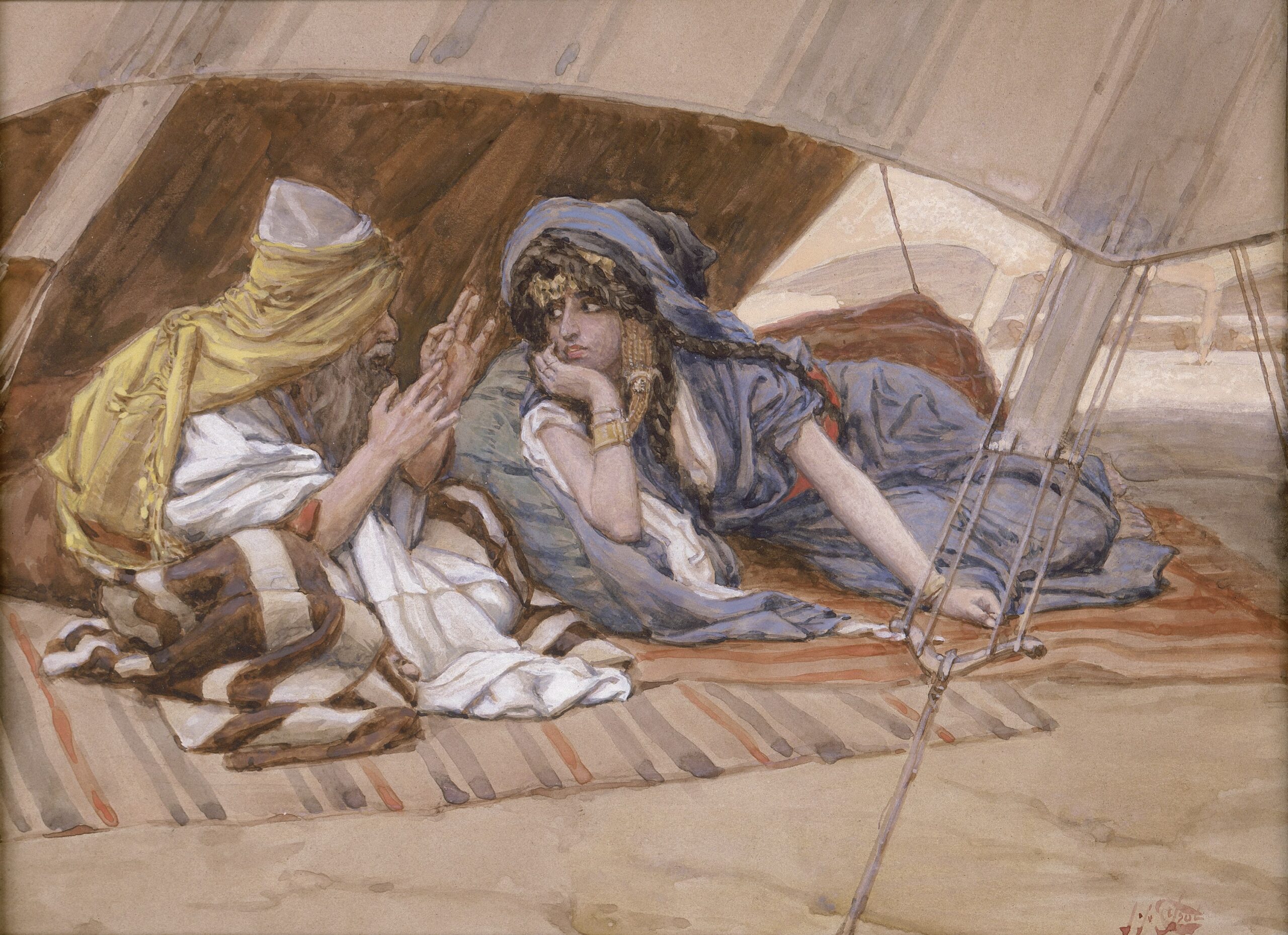
The feature image is James Tissot’s Abram’s Counsel to Sarai (1896–1902), The Jewish Museum, New York. Public domain.
[1] BDAG, s.v. “συγκληρονόμος.”
[2] All citations are from the NIV.
[3] Plutarch, Advice to Bride and Groom, 140D, in Moralia, vol. 2, trans. Frank Cole Babbitt, Loeb Classical Library (Cambridge, MA: Harvard University Press, 1928).
[4] Craig S. Keener, 1 Peter: A Commentary (Grand Rapids: Baker Academic, 2021), 245; Karen H. Jobes, 1 Peter, Baker Exegetical Commentary on the New Testament (Grand Rapids, Baker Academic, 2005), 209.