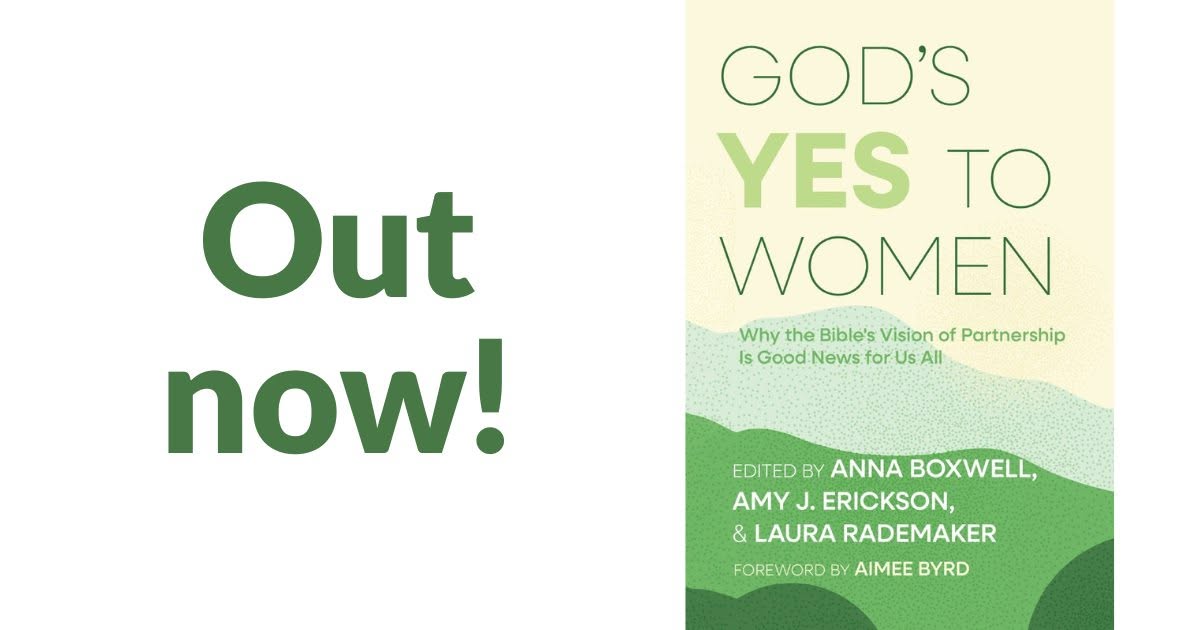
This new title, an edited volume to which I have contributed a chapter, has just been released:
God’s Yes to Women: Why the Bible’s Vision of Partnership Is Good News for Us All.
Although published in the United States, it is written by Australians (with the exception of Aimee Byrd, who wrote the foreward) primarily for Australians—though, of course, anyone interested in the topic may benefit from reading it. In her introduction, Laura Rademaker, outlines the purpose of the book:
We’re convinced that the Bible’s vision of women and men working together as servants of Jesus, as equal partners, without hierarchy or exclusion, and that this is good news for women and men: ultimately for everyone.
Part One contains nine chapters which outline a biblical and theological case for this full and equal partnership of women and men. Although the book is mainly about Christian ministry, my own chapter is about marriage: How the New Testament Turns Marriage on Its Head.
Unlike most approaches to marriage in the New Testament, I start with 1 Cor 7:1–5, where Paul describes the symmetrical and shared authority that spouses have over one another. I argue that 1 Corinthians 7 (and 6) should inform our readings of other passages which seem to imply (although I argue they do not) a hierarchy within marriage.
As a student of the New Testament, I believe we need to read such texts carefully. As a pastor, I am also conscious of the prevalence of domestic violence and the understandable reluctance many may feel in seeking help from (usually male) pastors. How we interpret these Scriptures has real-life consequences.
I also build on the work of Roy E. Ciampa and Brian S. Rosner, who argue that the verb “to touch” in 1 Cor 7:1 carries a pejorative sense. The CSB (2017) translates this well: “It is good for a man not to use a woman for sex.” This helps make sense of Paul’s argument, linking the mutual marital ethic of chapter 7 with his critique of sexual exploitation in 1 Corinthians 6. It also challenges long-standing interpretations that view Paul responding (in 1 Corinthians 7) to asceticism in Corinth.
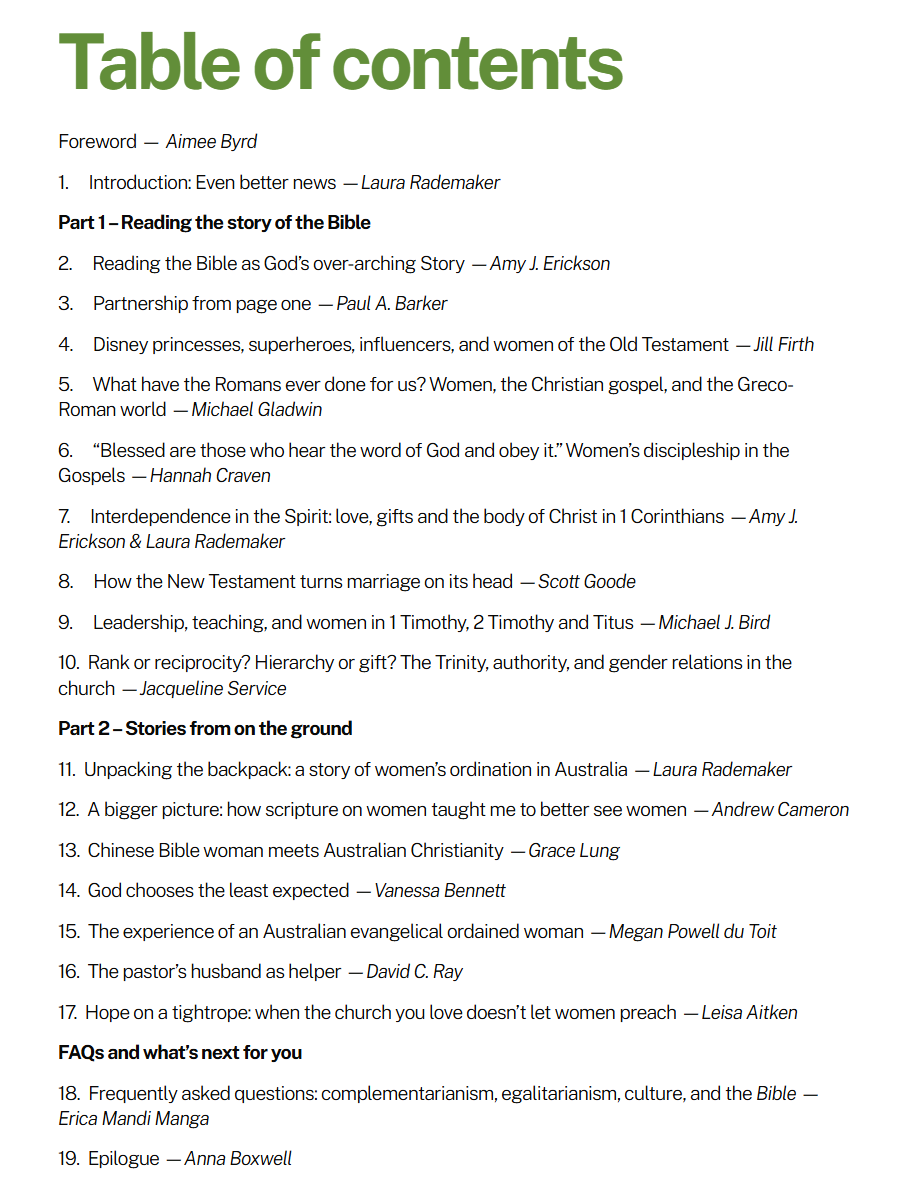
What makes this book distinctive is Part Two: Stories from on the Ground. The seven chapters in this section are insightful, informative, and challenging. They ask probing questions about belonging, power, theological discourse, and the human cost of our debates. Three chapters, in particular, caught my eye:
Laura Rademaker’s chapter, Unpacking the Backpack, outlines a brief history of the debate (1980s and 1990s) about gender roles in the Sydney Anglican Diocese. I was glad to read that this was a time when the arguments for and against the ordination of female priests were both recognised as “firmly and unashamedly evangelical.”
Andrew Cameron’s chapter, A Bigger Picture, sounds a warning against tribalism and echo chambers where “things always seem ‘clearer’ when everyone around you becomes inducted into the same view.” He cautions against using 1 Tim 2:11–12 as “divine command deontology,” where all other Scripture is then harmonised with it in ways that seem forced.
Leisa Aitken’s chapter, Hope on a Tightrope, invites us to practise “epistemic humility—that is, acknowledging that we cannot know anything perfectly or completely.” Leisa’s account of maturity is worth citing in full:
True emotional and relational maturity is shown in our capacity to define our own beliefs clearly, without attacking, withdrawing, or demanding someone else changes. We can express our own carefully thought-through position with gentleness and respect. As we speak with those who hold different views, we can be curious as to how it is they have come to hold their positions. Genuine curiosity can help us to resist any nasty labels about them we might whisper inside our minds. We also may need to resist any derogatory comments about them we voice to those who already agree with us. Such conversations create a triangle, which casts the third person as the enemy or outsider, and breeds factions and fractures in a community. Of course, we will discuss the issues with those with whom we agree, but let’s be respectful to those with whom we disagree, even when they are not present. Easier said than done! Let us love those who think differently while still holding hope for change.
I am thankful to the editors, Amy, Laura, and Anna, who invited me to write a chapter contributing to what has resulted in an accessible, generous, and rigorous exploration of the Bible’s vision for male–female partnership in ministry and, if you count my chapter, the home.